
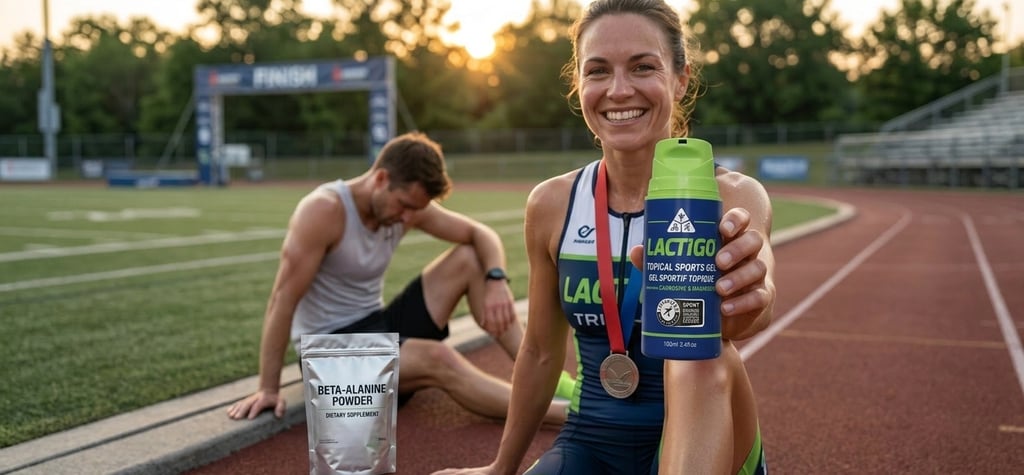
Beta-alanine has long been known as the gold standard method for raising the body's carnosine levels. New carnosine gel technology has changed many aspects of the future of carnosine usage — especially this one.
Carnosine (β-alanyl-L-histidine), a dipeptide found in high concentrations in skeletal muscle and brain tissue, plays a critical role in buffering pH, acting as an antioxidant, and supporting exercise performance. Raising muscle carnosine levels is a popular strategy among athletes and health enthusiasts to enhance endurance, delay fatigue, and potentially mitigate age-related decline. Two primary methods exist: supplementation with beta-alanine (the rate-limiting precursor of carnosine) and the use of topical carnosine gel.
Carnosine Synthesis and Its Importance
Carnosine is synthesised in the body from beta-alanine and histidine, with beta-alanine availability being the limiting factor. During high-intensity exercise, the accumulation of hydrogen ions lowers intramuscular pH, leading to fatigue. Carnosine buffers these ions, enhancing performance in activities lasting from 30 seconds to 10 minutes. Its antioxidant properties may also protect against oxidative stress, making it a molecule of interest for both athletic and therapeutic purposes.
Beta-Alanine Supplementation: Mechanism and Evidence
Beta-alanine supplementation increases muscle carnosine levels by providing the precursor needed for its synthesis. Studies suggest that a daily dose of 4–6 grams for 2–4 weeks can elevate muscle carnosine by 20–80%, with effects plateauing after 10–12 weeks. The International Society of Sports Nutrition supports its efficacy for high-intensity exercise, noting improvements in tasks lasting 1–4 minutes such as repeated sprints or time trials. However, it requires consistent intake over weeks, and benefits are mediated by gradual accumulation rather than immediate action.
A key limitation is paresthesia (tingling), which occurs with doses above 800 mg and can be mitigated with sustained-release formulations or divided doses. Research also indicates variability in response, influenced by baseline carnosine levels, muscle fibre type, and dietary habits — vegetarians with lower baseline levels show greater increases. Co-ingestion with carbohydrates or protein may enhance uptake, but the process remains slow, with washout of approximately 2% per week after cessation.
Topical Carnosine Gel: Mechanism and Evidence
Topical carnosine gel is the new arrival, even though it has been researched for close to 20 years. It delivers carnosine directly through the skin, bypassing the digestive system and first-pass metabolism. This transdermal approach aims to provide immediate availability to muscle tissue, avoiding the degradation that oral carnosine supplements undergo into beta-alanine and histidine.
A study involving AC Milan soccer players evaluated the gel's efficacy as an ergogenic aid, demonstrating a 5.41% improvement in distance travelled during a Yo-Yo intermittent recovery test and a 4.13% reduction in time for 3 x 1000 m runs after a single application (Sharpe & Macias, 2016). Notably, no loading phase was required, contrasting with beta-alanine's multi-week protocol.
Transdermal delivery also suggests potential for targeted application to fatigued muscles and may reduce systemic side effects. A recent investigation with the New Zealand All Blacks explored topical carnosine's impact on recovery and performance, suggesting rapid buffering capacity during match conditions, though further research is needed to confirm sustained benefits (Taylor et al., 2025).
Comparative Analysis
- Speed of action — Beta-alanine requires 2–4 weeks to significantly raise carnosine levels, with optimal effects after 10–12 weeks. Carnosine gel offers immediate benefits, making it ideal for acute performance boosts or pre-competition use.
- Absorption and bioavailability — Oral beta-alanine relies on gastrointestinal uptake and hepatic processing, with only a fraction converted to muscle carnosine. Topical gels bypass this, potentially offering higher local bioavailability, though systemic distribution is less clear.
- Side effects — Beta-alanine's paresthesia can deter users, despite being harmless; carnosine gel appears free of such effects, enhancing compliance. Skin sensitivity requires consideration.
- Sustainability — Beta-alanine sustains elevated carnosine with ongoing supplementation and a slow decline post-cessation. Gel effects may be more transient, necessitating repeated applications; long-term data are lacking.
- Cost and accessibility — Beta-alanine supplements are widely available at roughly $0.20–$0.50 per day. Carnosine gels are niche products, potentially more expensive and less accessible.
- Athletic application — The All Blacks work highlights the gel's potential for elite recovery, while beta-alanine's established use across cycling and rowing suits long-term training cycles. The AC Milan study underscores the gel's acute ergogenic potential for soccer's intermittent demands.
Scientific Considerations and Future Directions
While beta-alanine's efficacy is well documented, its slow loading and side effects prompt scrutiny of its practicality for all users. Carnosine gel's rapid action challenges the traditional supplementation paradigm, but its mechanisms — skin penetration, systemic versus local effects — need further validation. Studies such as those with AC Milan and the All Blacks suggest transdermal delivery could reshape ergogenic aids, yet larger trials are required to assess consistency across populations and exercise types. Diet, muscle fibre composition, and individual metabolism also warrant exploration to optimise both methods.
Conclusion
Beta-alanine is the former champion for long-term carnosine elevation, supported by extensive research and suitable for sustained performance gains. Oral carnosine supplementation has never proven to rival it, given the body's effective measures to break it down. Carnosine gel offers a promising alternative for immediate benefits, particularly in high-stakes or acute scenarios, and is one of the only products mandated to be stocked in National Hockey League dressing rooms.
Outside of laboratory testing it is difficult to measure the effectiveness of beta-alanine in individual subjects. Carnosine gel, on the other hand, delivers near-immediate demonstrable results in many targeted areas.
In a market where consumers and elite athletes alike are looking for results-driven products, carnosine gel is the clear choice for rapid, targeted support. For the 99th percentile, a combined approach may take advantage of the best of both worlds.
The anecdotal evidence pouring in from user experience is driving the focus for new areas of research — a unique situation where experience is driving the research instead of the research driving the experience.